Manuscript presentation
How narration and reading tools show a book's text to the person at the screen, redrawn in this app's colours, followed by proposals for how SpokenWords may present the manuscript and the original document together. Every mock keeps what SpokenWords has settled on: the waveform and recording buttons at the bottom, the table of contents in the optional left panel, and details in the right panel.
Tobi
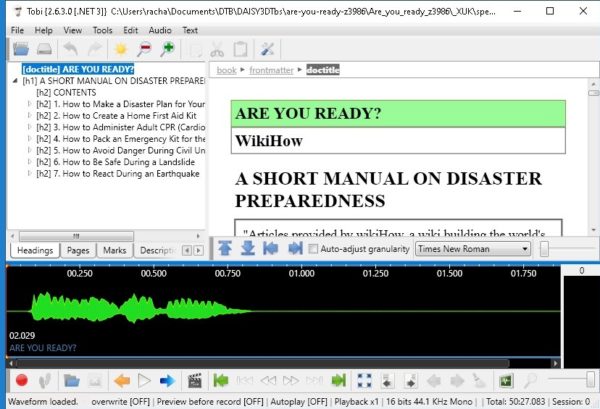
The DAISY Consortium's authoring tool for full-text, full-audio talking books. The Navigation pane on the left is a tree of the book's headings, with tabs for Headings, Pages, Marks and Descriptions along its bottom edge. The Document pane on the right shows the whole book in a large serif face under a structure trail naming the selected element's ancestors; the selected item is filled green. A toolbar under the document sets the working granularity and the font. The bottom of the window is a waveform pane, green on black, with the selected phrase's text under it, then the transport buttons and a status line. There is no right-hand pane.
- [doctitle] Chapter 1 THE FOUNDATIONS
- [h1] 1.1 Cellular Foundations
- [h2] Cells Are the Structural Units
- [h2] Cellular Dimensions Are Limited
- [h1] 1.2 Chemical Foundations
- [h2] Biomolecules Are Compounds of Carbon
Chapter 1 THE FOUNDATIONS OF BIOCHEMISTRY
1.1 Cellular Foundations
Biochemistry aims to explain biological form and function in chemical terms.
Take from it: the same three bands SpokenWords has, tree left, text centre, audio at the bottom; the selected item is a filled block in the document, and the trail above the text says where you are in the hierarchy.
Sources: Tobi screenshot (daisy.org), Tobi user interface.
Obi
The DAISY Consortium's audio-only production tool. There is no document text: a TOC tree on the left, and on the right one strip per section holding phrase blocks. Each block shows the phrase's number within the section, its duration and its waveform. Phrases carry roles (page, heading, silence, to-do, unused) that the block marks, and a floating record toolbar sits over the content.
- Chapter 1
- 1.2 Chemical Foundations
- 1.3 Physical Foundations
Take from it: a phrase's role (page, heading, to-do) is drawn on the block itself; sections are visible groups, not a flat list.
Source: Obi functions.
Dolphin Publisher
Used by talking-book producers for DAISY and EPUB. The producer marks the HTML into
sentence events, <span class="sentence"> by default, then the
narrator records with "Sync as you speak": one keypress moves the next text event to
the playhead. In the recording view the document fills the window under a toolbar, the
paragraph being recorded is filled yellow, a narrow waveform strip runs under the text,
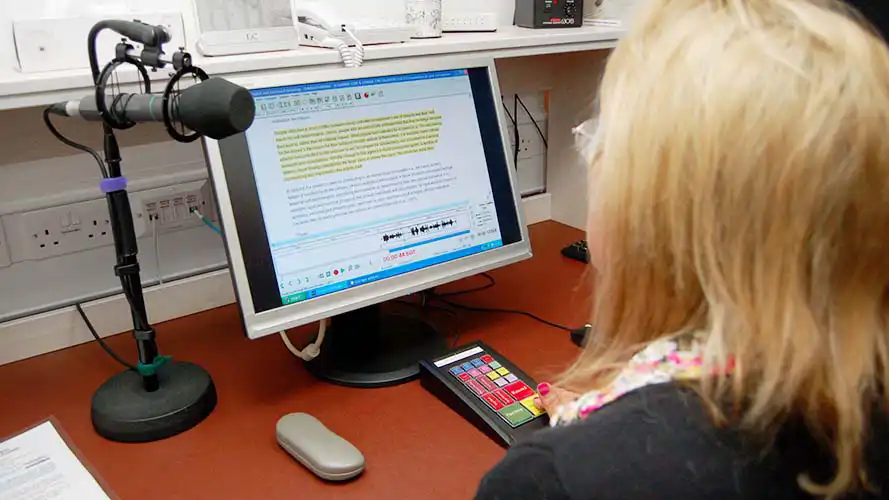
and the transport with its time counter sits at the bottom. The narrator in Dolphin's
own photograph works with a dedicated keypad beside the keyboard.
1.2 Chemical Foundations
Biochemistry aims to explain biological form and function in chemical terms. By the late eighteenth century, chemists had concluded that the composition of living matter is strikingly different from that of the inanimate world. Antoine-Laurent Lavoisier noted the relative chemical simplicity of the mineral world.
He contrasted it with the complexity of the plant and animal worlds. Lavoisier noted that the fundamental building blocks are the same in both.
Take from it: when the units the audio is cut into are invisible in the layout, paint them; the filled block is the whole cue.
Sources: Dolphin's recording photograph, Dolphin Publisher 3.5 manual § 3.3 and § 5.11.
Hindenburg Narrator
A recording workstation for audiobooks, developed with the Danish and Norwegian talking-book libraries NOTA and NLB, exporting to ACX, DAISY and EPUB 3. The audio tracks take the upper half of the window as a full-width waveform under a dense toolbar and time ruler. Below, a Contents pane lists the book's chapters as a tree with a checkbox per entry, and a Manuscript pane beside it shows the book as it was imported, cover page included. The transport with its time counter runs along the bottom. Clicking in the text moves the playhead, punch-and-roll starts from that click, and "Leaf mode" shows all text, H1 and subheadings, or the current heading only.
- ☑ Lehninger principles
- ☑ Chapter 1
- ☐ 1.2 Chemical Foundations
- ☐ 1.3 Physical Foundations
- ☐ Chapter 2
1.2 Chemical Foundations
Biochemistry aims to explain biological form and function in chemical terms. By the late eighteenth century, chemists had concluded that the composition of living matter is strikingly different from that of the inanimate world.
Take from it: audio above, text below, contents beside the text; the inverse vertical order of SpokenWords with the same three parts.
Sources: Hindenburg product screenshot, Hindenburg Narrator, Author Media walkthrough.

ElevenLabs Studio
AI narration from an EPUB. Chapters sit in a sidebar; within a chapter the text is a column of paragraph blocks. Each block has a bar at its left, pale grey until audio has been generated and dark grey after, and a coloured voice orb; the text of that voice is highlighted in the same colour. A contextual sidebar shows the selected block's settings, and a timeline runs along the bottom.
- Chapter 1
- Chapter 2
- Chapter 3
Speed: 1.0
Fade in / out
▶ Generate
Take from it: per-block state lives in a fixed left gutter and nothing else moves; a second colour channel (the voice) tints the text itself.
Sources: Studio overview, voices per paragraph.
Google Play Books auto-narration
The audiobook text editor shows the book text with words that need attention marked inline; a pronunciation check lists them by category (names, organisations, spelled-out words, numbers) in a panel, alternate pronunciations open on the right, and a play button per word plays every occurrence. Voice, language and speed apply per section.
1.2 Chemical Foundations
By the late eighteenth century, chemists had concluded that the composition of living matter is strikingly different from that of the inanimate world. Antoine-Laurent Lavoisier noted the relative chemical simplicity of the mineral world.
The tiny bacterium E. coli contains some 4,400 different proteins.
lah-vwah-ZYAY ▶
la-VOY-see-er ▶
E. coli
ee KOH-lye ▶
Take from it: word-level attention marks stay in the text; the list of them lives in the right panel, which is where SpokenWords already puts annotations.
Source: Check and adjust pronunciation.
Pozotron
Proofing and script preparation for narrators. In proofing, the manuscript scrolls in sync with the audio, and missed, inserted and mispronounced words are annotated inline and collected as a pickup list. Script preparation exports the manuscript with character names highlighted and pronunciation comments beside difficult words.
By the late eighteenth century, chemists had concluded that the composition of living matter is strikingly different from that of the inanimate world.
Antoine-Laurent Lavoisier noted the the relative chemical simplicity of the mineral world.
He contrasted it with the complexity of the plant and animal worlds.
01:31 added "the"
02:04 pronunciation "Lavoisier"
Take from it: the same underline and strike vocabulary SpokenWords uses for mismatches; the pickup list is the reviewer's surface, not the narrator's reading surface.
Sources: Pozotron proofing, script preparation.
Synchronized-text readers
Legimus (MTM's own app), Dolphin EasyReader, Thorium Reader, Voice Dream Reader and Kindle's Immersion Reading all show a talking book the same way: the book's own layout, headings, page numbers, lists, tables and pictures included, with a highlight moving over the current sentence or word as the audio plays. Legimus draws the book in a sans-serif face with the page number in the right margin, the current sentence filled yellow, and a dark bar along the bottom holding the cover, elapsed and remaining time, the navigation level and the transport. EasyReader's text settings sheet has text size, margins, line spacing, letter spacing, image descriptions, a centred highlight, the number of lines visible, the font and the colour theme.
Biochemistry aims to explain biological form and function in chemical terms.
By the late eighteenth century, chemists had concluded that the composition of living matter is strikingly different from that of the inanimate world. Antoine-Laurent Lavoisier noted the relative chemical simplicity of the mineral world.
1.2 Chemical Foundations
He contrasted it with the complexity of the plant and animal worlds.
- Text size
- Margins
- Line spacing
- Letter spacing
- Center highlight
- off
- Lines visible
- All
- Font
- Book's default
- Colour theme
Take from it: nobody flattens the book; the highlight is the only thing that moves; the reader owns type size, spacing, face, theme and highlight.
Sources: Legimus and Dolphin EasyReader App Store screenshots (2026-09-10), Legimus settings, EasyReader features, Thorium reading settings, Voice Dream feature list.
webarch content editor
The editor in webarch, which prepares the WDF SpokenWords imports, embeds a recorder. The document fills the page under a fixed TinyMCE toolbar; there is no side table of contents, only a "Table of contents" link under the title, and every heading carries a blue bar at its left and a small margin label naming its level. The sentence being recorded is marked in the document as an inverted block, dark fill and white text. The recorder is a sheet fixed along the bottom, a light grey gradient 250 px tall, holding three lines in large sans-serif: the previous sentence at 20 percent opacity, the current sentence at medium weight, the next at 20 percent. Under the lines, centred, sit the latency label and the previous, record, next, settings and close buttons; the audio player bar lies behind the sheet.
↓ Table of contents
H21.2 Chemical Foundations
Biochemistry aims to explain biological form and function in chemical terms. By the late eighteenth century, chemists had concluded that the composition of living matter is strikingly different from that of the inanimate world.
VAntoine-Laurent Lavoisier noted the relative chemical simplicity of the mineral world.
H2Lavoisier's insight
He contrasted it with the complexity of the plant and animal worlds.
Take from it: one sentence in focus with one line of context each way is enough to record from; the document above answers "where am I", the sheet below answers "what do I say". The current sentence is marked in both places at once.
Source: the recorder in webarch's content editor, measured on the live editor on 2026-09-10.
SW 1: the manuscript with the document's rhythm
One sentence per row and the status dot in a fixed left gutter, as today, but the rows take the document's shape from each sentence's path in the source: headings in heading type, paragraphs separated by a block gap and their sentences by the line-height setting alone, list items indented per level with a small gap between siblings, a table kept as one block with a hairline between its rows and bold header cells, and an announced container (quote, sidebar, note, code) framed by a left rule from its opening announcement to its closing one. Announcements carry one icon naming the container and no label; textless ones are hidden. A page break is a rule with the number at the edge, as in Tobi.
- ▾ Bodymatter
BODY MATTER - Chapter 1
Recording · ARTICLE - Chapter 2
- 1.2 Chemical Foundations
- Biochemistry aims to explain biological form and function in chemical terms.
- By the late eighteenth century, chemists had concluded that the composition of living matter is strikingly different.
- Antoine-Laurent Lavoisier noted the relative chemical simplicity of the mineral world.
- Page 12
- Cells are the fundamental unit of life.
- Every cell is bounded by a plasma membrane.
- Its lipids are held together by weak interactions.
Table. - TABLE 1-1 Molecular components of an E. coli cell
- Component
- Percentage of total weight
- Water
- 70
- Proteins
- 15
End of table.
Sentence 168
Why: it is what was asked for on 2026-09-10, it needs no second fetch because every sentence already carries its source path, and it keeps every painter in the reader working on the same flat rows. It is the base that SW 2 to SW 5 build on.
SW 2: original document above the manuscript
The webarch arrangement, in the Studio's frame. The rendered document takes the upper part of the centre column, scrolled so the current sentence's block is in view and highlighted, and the manuscript below it shows a short window of rows around the current sentence. The waveform and recording buttons stay at the bottom, the table of contents left, details right. The divider between document and manuscript drags, and either pane can be collapsed, which returns to today's single view.
1.2 Chemical Foundations
Biochemistry aims to explain biological form and function in chemical terms. By the late eighteenth century, chemists had concluded that the composition of living matter is strikingly different from that of the inanimate world. Antoine-Laurent Lavoisier noted the relative chemical simplicity of the mineral world. He contrasted it with the complexity of the plant and animal worlds.
12Cells are the fundamental unit of life.
- ▾ Bodymatter
BODY MATTER - Chapter 1
Recording · ARTICLE - Chapter 2
- By the late eighteenth century, chemists had concluded that the composition of living matter is strikingly different.
- Antoine-Laurent Lavoisier noted the relative chemical simplicity of the mineral world.
- He contrasted it with the complexity of the plant and animal worlds.
Sentence 168
Why: the narrator reads context from the book and the exact line from the manuscript, as in webarch and Hindenburg. Cost: the document pane needs the synchronized highlight the separate window already has, and the manuscript loses its overview role, so the status dots for the chapter move to the navigator or the right panel.
SW 3: original document beside the manuscript
Two columns in the centre: the manuscript on the left with its full row list, the rendered document on the right, both scrolled to the current sentence. The right details panel yields to the document while it is open, or the document takes the right panel's slot as a third tab there. This was the planned layout for the original-document pane, drawn against the settled bottom bar.
- ▾ Bodymatter
BODY MATTER - Chapter 1
Recording · ARTICLE - Chapter 2
- 1.2 Chemical Foundations
- Biochemistry aims to explain biological form and function in chemical terms.
- By the late eighteenth century, chemists had concluded that the composition of living matter is strikingly different.
- Antoine-Laurent Lavoisier noted the relative chemical simplicity of the mineral world.
- He contrasted it with the complexity of the plant and animal worlds.
- Page 12
- Cells are the fundamental unit of life.
1.2 Chemical Foundations
Biochemistry aims to explain biological form and function in chemical terms. By the late eighteenth century, chemists had concluded that the composition of living matter is strikingly different from that of the inanimate world. Antoine-Laurent Lavoisier noted the relative chemical simplicity of the mineral world. He contrasted it with the complexity of the plant and animal worlds.
- 12Cells are the fundamental unit of life.
Why: both surfaces keep their full height, so the manuscript's status overview survives and the document shows a whole table or figure at once. Cost: two reading columns compete for width on a laptop; below about 1200 px one must collapse, which SW 2 handles better.
SW 4: the document is the manuscript
One surface instead of two: the rendered document with the status gutter added to it. Every sentence host in the document gets a dot in the left margin, the current sentence is highlighted in place, and a paragraph's sentences stay a paragraph. Headings, lists and tables are the real elements, drawn as the article view draws them. The manuscript's own affordances, word mode, mismatch underlines and inline waveform, attach to the same sentence hosts. Dolphin's alternating sentence fill can be an option for narrators who want the units visible.
- ▾ Bodymatter
BODY MATTER - Chapter 1
Recording · ARTICLE - Chapter 2
1.2 Chemical Foundations
Biochemistry aims to explain biological form and function in chemical terms. By the late eighteenth century, chemists had concluded that the composition of living matter is strikingly different from that of the inanimate world. Antoine-Laurent Lavoisier noted the relative chemical simplicity of the mineral world. He contrasted it with the complexity of the plant and animal worlds.
| Component | % of weight |
|---|---|
| Water | 70 |
| Proteins | 15 |
Sentence 168
Why: it is what every reader does and removes the second surface entirely. Cost: the largest change. A sentence is no longer a row: a paragraph's dots stack at its left edge, a table cell's dot has nowhere to sit, announcement rows have no element of their own, and the reader's painters, word mode and roving tabindex are all written for sibling rows. It is the end state SW 1 moves toward, not a next step.
SW 4a: one dot per sentence, inside the document
The merged view of SW 4 with today's dot kept one for one. The first sentence of a block has its dot in the margin as now; the second and later sentences of a paragraph carry theirs inline, between the words, since there is no margin to sit in. Each dot is the same button as today: the roving tab stop, the sentence's spoken name, Enter for the sentence menu. The sentence's own text takes the status tint the row has today, because every sentence host in the document already carries its sync id, so the dot can stay near-invisible at rest. In a list item the dot shares the line with the list marker; in a table it sits at the start of each cell.
- ▾ Bodymatter
BODY MATTER - Chapter 1
Recording · ARTICLE - Chapter 2
1.2 Chemical Foundations
Biochemistry aims to explain biological form and function in chemical terms. By the late eighteenth century, chemists had concluded that the composition of living matter is strikingly different from that of the inanimate world. Antoine-Laurent Lavoisier noted the relative chemical simplicity of the mineral world. He contrasted it with the complexity of the plant and animal worlds.
- Cells are the fundamental unit of life. Every cell is bounded by a plasma membrane.
| Component | % of weight |
|---|---|
| Water | 70 |
Keeps: one keystroke to any sentence, one spoken name per sentence, every sentence's status visible. Costs: a dot between words in running prose, and beside the marker in a list.
SW 4b: one dot per block, opening a nested menu
The merged view with one dot per block in the margin, a paragraph, heading, list item or table row, the way ElevenLabs marks paragraphs and Tobi points at items. The dot carries the block's summary, "Paragraph 12, four sentences, one rejected", and Enter opens a menu listing the block's sentences with their status; Enter on a sentence opens today's sentence menu as a submenu. A table's opening and closing announcements become the first and last entries of the table's menu instead of needing an element of their own. The sentence text carries the status tint, since the dot no longer sits beside each sentence. Tobi's granularity switch fits here as a narrator setting: whether the arrow keys walk blocks or sentences.
- ▾ Bodymatter
BODY MATTER - Chapter 1
Recording · ARTICLE - Chapter 2
1.2 Chemical Foundations
Biochemistry aims to explain biological form and function in chemical terms. By the late eighteenth century, chemists had concluded that the composition of living matter is strikingly different from that of the inanimate world. Antoine-Laurent Lavoisier noted the relative chemical simplicity of the mineral world. He contrasted it with the complexity of the plant and animal worlds.
- Cells are the fundamental unit of life. Every cell is bounded by a plasma membrane.
| Component | % of weight |
|---|---|
| Water | 70 |
Keeps: a clean margin and a straight dot column, fewer tab stops across a chapter, announcements without elements of their own. Costs: Enter then arrow to reach a sentence, and the tint on the text becomes required, with a shape beside the colour where two statuses meet in one paragraph.
SW 5: current block only
Tobi's single-phrase mode and Hindenburg's leaf mode, on the Studio's focus mode. The centre column shows only the block being recorded, a paragraph, a list item or a table row, at a larger size, with the previous and next block dimmed above and below and the rest of the chapter out of view. The bottom bar and the panels behave as focus mode does today. Leaving focus returns to SW 1's full column at the same sentence.
- By the late eighteenth century, chemists had concluded that the composition of living matter is strikingly different.
- Antoine-Laurent Lavoisier noted the relative chemical simplicity of the mineral world.
- He contrasted it with the complexity of the plant and animal worlds.
- Lavoisier noted that the fundamental building blocks are the same.
- Cells are the fundamental unit of life.
Why: the block is the unit a narrator reads in one breath group, and every tool that has a reading mode narrows to it. Cost: small once SW 1 exists, because the block boundaries are the same attributes.
SW 6: the reading settings the readers have
The Studio already lets the narrator set text size, line spacing and column width, and the theme. Every synchronized-text reader adds a font face, with a sans-serif and a dyslexia face beside the serif, and the highlight colour for the current sentence. Both fit the existing settings popover and apply to the manuscript and the document pane alike, since they read the same custom properties.
- Biochemistry aims to explain biological form and function in chemical terms.
- By the late eighteenth century, chemists had concluded that the composition of living matter is strikingly different.
- Antoine-Laurent Lavoisier noted the relative chemical simplicity of the mineral world.
- Size
- Line spacing
- Width
- Face
- Literata · Inter · Dyslexic
- Highlight
Why: it is the one presentation control every reader offers that the Studio lacks. Cost: a dyslexia face is a new local font file; the highlight colour is one token.
SW 7: the document while narrating, the sentence list on demand
Two surfaces, one at a time. The rendered document is what the narrator reads from, with the recording bar below it and the current sentence highlighted; a switch in the header, or a key, brings up the sentence list of SW 1 at the same position, with the dots, the sentence menus, the mismatch underlines and word mode, and the same switch returns. Both surfaces exist today and already share the position over the sync id, so the switch is the `ui-tab` / `ui-outlet` view switcher rather than a new surface. What the document cannot show is anything word-level, because it renders no word spans; that stays on the list.
- ▾ Bodymatter
BODY MATTER - Chapter 1
Recording · ARTICLE - Chapter 2
1.2 Chemical Foundations
Biochemistry aims to explain biological form and function in chemical terms. By the late eighteenth century, chemists had concluded that the composition of living matter is strikingly different from that of the inanimate world. Antoine-Laurent Lavoisier noted the relative chemical simplicity of the mineral world. He contrasted it with the complexity of the plant and animal worlds.
- Cells are the fundamental unit of life. Every cell is bounded by a plasma membrane.
| Component | % of weight |
|---|---|
| Water | 70 |
- ▾ Bodymatter
BODY MATTER - Chapter 1
Recording · ARTICLE - Chapter 2
1.2 Chemical Foundations
Biochemistry aims to explain biological form and function in chemical terms. By the late eighteenth century, chemists had concluded that the composition of living matter is strikingly different from that of the inanimate world. Antoine-Laurent Lavoisier noted the relative chemical simplicity of the mineral world. He contrasted it with the complexity of the plant and animal worlds.
- Cells are the fundamental unit of life. Every cell is bounded by a plasma membrane.
| Component | % of weight |
|---|---|
| Water | 70 |
- ▾ Bodymatter
BODY MATTER - Chapter 1
Recording · ARTICLE - Chapter 2
- 1.2 Chemical Foundations
- Biochemistry aims to explain biological form and function in chemical terms.
- By the late eighteenth century, chemists had concluded that the composition of living matter is strikingly different.
- Antoine-Laurent Lavoisier noted the relative chemical simplicity of the mineral world.
- He contrasted it with the complexity of the plant and animal worlds.
- Cells are the fundamental unit of life.
- Every cell is bounded by a plasma membrane.
Table. - TABLE 1-1 Molecular components of an E. coli cell
- Component
- Percentage of total weight
- Water
- 70
Keeps: both surfaces unchanged, each doing what it does best. Costs: a switch to act on a sentence, and in the first form a switch to learn a sentence's status; the second form needs one painter over the sync-id hosts and a shape beside the colour.
Reading the proposals together
SW 1 is the change already planned and is the base for the others. SW 2 and SW 3 are the two ways to keep both surfaces in view at once, the first favouring a laptop and the second a wide screen; SW 7 keeps both surfaces and shows one at a time. SW 4 is where the two become one, and SW 4a and SW 4b are the two ways the status dot survives that merge: per sentence inline, or per block with a nested menu. SW 5 and SW 6 are small once SW 1 exists.
The developer meeting on 2026-09-10 chose SW 4a. Manuscript presentation 2 draws that direction on the studio as it is today, with the view and spoken-form toggles it needs and the five places they could sit.